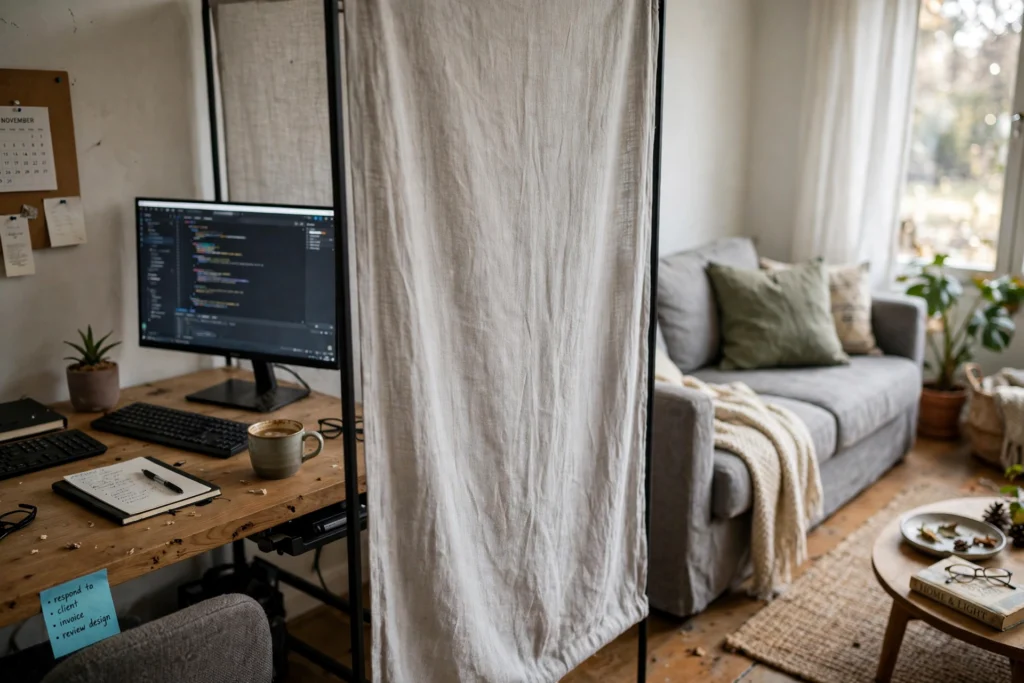
How to Separate Work and Home Life in One Room
By Maya Bennett, Founder & Editor. Working and living in one room blurs the line between the two, and the day never quite ends. The fix is not a bigger house. It is a set of clear signals that tell you, and everyone else in the room, when you are working and when you are not. These seven steps draw that line with a divider, one desk, a closing ritual, and habits you can repeat every day. For more ideas in this series, browse the Home Office Ideas category.
As an Amazon Associate I earn from qualifying purchases. Please see our affiliate disclosure for details. This article prints no prices, because prices change. Check the listing before you buy, and confirm you have the exact variant named.
In this article
At a glance
| Step | What it does |
|---|---|
| 1. Draw the line with a divider | Creates a visible work zone without building a wall |
| 2. Give work one desk and nothing else | Stops work spreading across every surface in the room |
| 3. Pack the day away in a rolling cart | Gives work a home on wheels that leaves the room at night |
| 4. Wear the signal that you are working | Tells the room you are busy without saying a word |
| 5. Build a shutdown ritual | Ends the workday with the same steps every night |
| 6. Start the day the same way | Opens the workday with a calm routine instead of a scramble |
| 7. Reset the room in the evening | Returns the room to home mode so the evening feels restful |
1. Draw the line with a divider
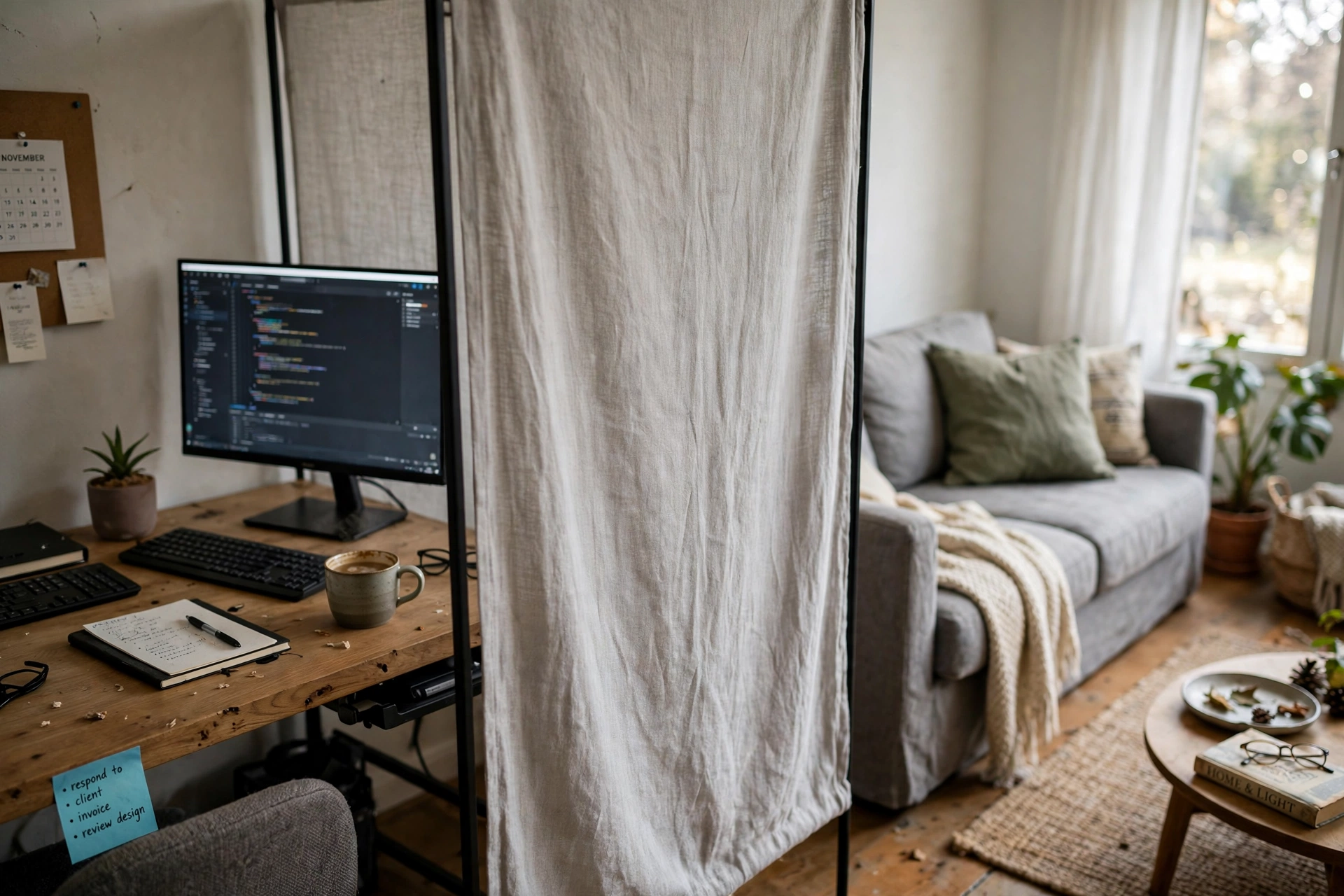
A divider is the fastest way to split one room into two jobs. It blocks the sight of the sofa from your desk, and it blocks the sight of your desk from the sofa, so each side of the room feels like its own place. You do not need a tall or heavy screen. A panel at seated eye height does most of the work.
Pick a divider you can move in seconds, because the room still needs to change shape for guests and for evenings. A clamp-on desk panel works when the desk sits against a wall, while a freestanding screen suits a desk in the middle of the room. Either way, the line should be easy to see and easy to cross when the day ends.
AI-generated image
Why this one: It clamps to the desk, cuts the visual noise of the room, and the fabric softens sound a little, all without building a wall.
Worth knowing: It is one panel only, so a wide desk needs more than one, and the clamps fit desks only up to a set thickness.
2. Give work one desk and nothing else
Work spreads to fill every flat surface it finds, so give it exactly one desk and defend that boundary. Everything for work lives on that desk or in its drawer, and nothing for work lives on the dining table, the sofa, or the kitchen counter. When the desk is the only work surface, leaving it means leaving work.
A height adjustable desk helps here, because changing the height marks the change between sitting work and standing work, and the drawer hides the small clutter that makes a desk look like a junk drawer. Keep the desk clear enough that you can sit down and start in a minute, without clearing a space first.
- One desk for work, and no work anywhere else in the room
- A drawer for the small clutter, so the surface stays clear
- Sit down and start in a minute, with no clearing first

AI-generated image
Why this one: The electric lift switches sitting and standing in seconds, the memory presets remember your two heights, and the drawer hides the small clutter.
Worth knowing: It is a single motor desk, so it can wobble a little at full height, and the top holds less weight than a heavy dual motor frame.
3. Pack the day away in a rolling cart
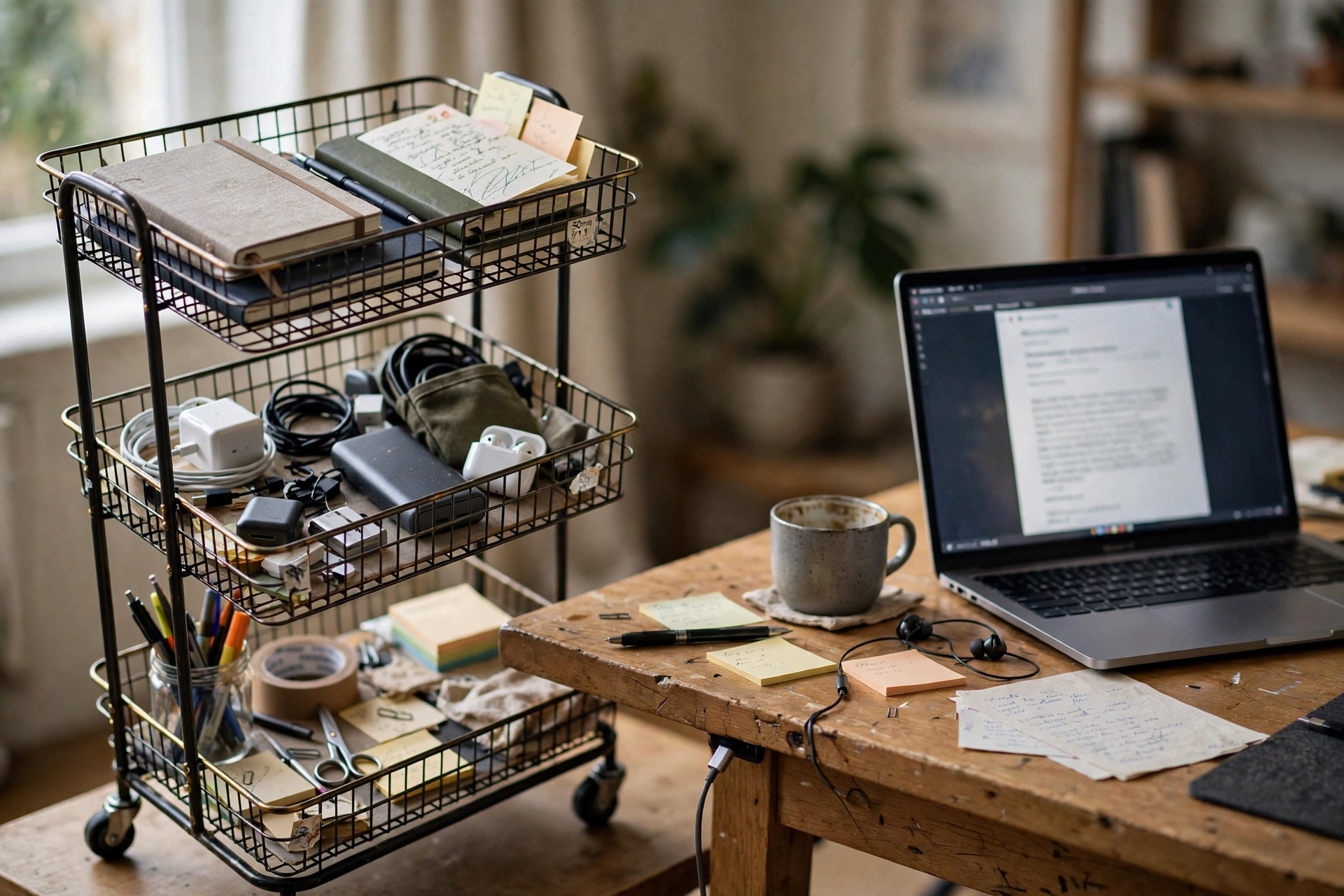
A rolling cart is a desk drawer you can push into a corner. Load it with the notebook, the chargers, the papers, and the headset, and roll it beside the desk in the morning. At night, roll it away, and the room stops looking like an office. The cart holds the whole workday, and it takes up no more floor than a small side table.
Keep the top tier for the things you reach for all day, the middle tier for papers, and the bottom tier for the heavy items that keep the cart steady. Label the tiers if more than one person uses the cart, so nothing migrates onto the dining table by mistake.
AI-generated image
Why this one: It holds the whole workday on three tiers, rolls away when work ends, and the pegboards keep small tools visible instead of buried in a drawer.
Worth knowing: The pink color is bold for a plain room, and the cart is light, so load the heavy items low to keep it steady when you roll it.
4. Wear the signal that you are working
In a shared room, people cannot tell when you are free and when you are deep in work, so give them a signal they can see. Headphones are the clearest one. Put them on when you start a focused block, and take them off when you are free to talk. The household learns the signal in a week, and interruptions drop fast.
Noise cancelling helps too, because it hushes the television and the kitchen while you work. You do not need music playing. Silence behind the headphones is fine, and the closed door feeling helps you focus even when the room is busy around you.
- Put the headphones on at the start of a focused work block
- Take them off between blocks, so people know you are free
- Keep calls and music on the headphones, not on speakers

AI-generated image
Why this one: The noise cancelling hushes the room, the mic is clear on calls, and one charge lasts through a long workday.
Worth knowing: They are a premium buy for a simple focus signal, and the touch controls take a few days to learn without accidental taps.
5. Build a shutdown ritual
A shutdown ritual is a short list of steps you repeat every evening, and it is the strongest boundary in this whole article. Clear the desk, close the laptop, write tomorrow’s first task on a card, and switch the lamp off. Do it in the same order every night, and your brain learns that the ritual means work is over.
The ritual works because it is physical, not just a thought. You move your hands, you close things, you walk away from the desk. If you skip it, work follows you to the sofa, because nothing told you the day had ended. Five minutes at the desk saves an evening of half working.
- Clear the desk and close the laptop
- Write tomorrow’s first task on a card
- Switch the lamp off and walk away from the desk

AI-generated image
6. Start the day the same way
A steady morning routine is the other half of the shutdown ritual. Roll the cart back, open the laptop, read the card you wrote last night, and start on that one task before you open email. The routine takes ten minutes, and it stops the day from starting with a rush through messages.
Keep the routine the same on good days and bad days, because the sameness is the point. You are not deciding how to start work. You are following a path you already laid out, and the decision is already made. That is what keeps a shared room from feeling chaotic in the morning.
- Roll the cart back and open the laptop
- Read the card from last night and start on that task
- Open email only after the first task is moving

AI-generated image
7. Reset the room in the evening
Once the shutdown ritual is done, reset the room itself. Fold the divider back, put the work cart in its corner, and straighten the cushions. The room should look like a living room again, not like an office that is waiting for you. That visual reset matters, because you relax where you look, and a desk in view keeps work in mind.
Do the reset with the people you live with, so it becomes a shared habit instead of one person’s job. A two minute tidy together beats a ten minute tidy alone, and it reminds everyone that the room belongs to home life in the evening. Then sit down and enjoy the room you just gave back to yourself.
- Fold the divider back and park the cart in its corner
- Straighten the cushions and clear the work things away
- Sit in the room as a living room, not as an office

AI-generated image
Frequently asked questions
How do I separate work and home life without a spare room?
Use visible signals instead of walls. One desk, a divider, headphones on for focus, and a shutdown ritual every evening draw a line that everyone in the room can see and respect.
What if my partner or family keeps interrupting me?
Agree on the signals together, and keep them simple. Headphones on means do not interrupt unless it is urgent, and a closed laptop means the day is over. Signals only work when everyone knows what they mean.
Should I work from the sofa sometimes?
Keep work at the desk as much as you can. The sofa is home territory, and working there teaches your brain that home is also work. Save the sofa for rest, and the boundary stays clear.
How long should a shutdown ritual take?
Five minutes is enough. Clear the desk, close the laptop, write the next task, and switch the lamp off. A longer ritual gets skipped on tired evenings, and a skipped ritual helps no one.
What if I work late some nights?
Keep the ritual even on late nights, and keep it short. A late finish is still a finish, and the room still needs to go back to home mode before you sleep.
Conclusion
Separating work and home life in one room is a set of signals, not a renovation. One desk, a divider, headphones for focus, and a shutdown ritual every evening draw a line you can see. Cross it in the morning, cross back at night, and the same room can hold both a good workday and a restful evening. For more ideas, browse the Home Office Ideas category.
